Engine Repair or Replace in Dubai? How to Decide
Engine trouble is the repair every Dubai driver dreads, and with reason. It is the one job where the gap between the cheapest sensible option and the most expensive one runs into tens of thousands of dirhams — and where the decision is often made badly, under pressure, on the advice of whoever happens to be quoting.
The good news is that "engine problem" covers an enormous range. A great many faults that sound catastrophic are a gasket, a sensor, or a timing component, and are fixed for a fraction of what people fear. The bad news is that a genuinely damaged engine in Dubai almost always got that way for the same reason: heat, and the decision to keep driving after the first warning.
This guide separates the repairable from the terminal, explains the four options you actually have here — most guides only describe three — and gives realistic 2026 Dubai costs for each.
If the engine is knocking, has overheated badly, or the oil looks milky, stop driving it. Every additional kilometre in that condition is what turns a repair into a replacement.
First: Is the Engine Actually Finished?
Before anyone quotes you for a rebuild, establish what has actually failed. These two lists are the fastest way to know which conversation you are having.
Usually repairable
- White smoke from the exhaust with coolant loss. Often a head gasket. Serious, but a defined job
- Oil leaking from a gasket or seal, with normal running otherwise
- A check engine light with a specific fault code and no unusual noise
- Rough idle or a misfire — commonly coils, plugs or injectors
- Rattling on start-up that settles — frequently a timing chain tensioner
- Loss of power with a whistling or hissing noise — often a turbo or a boost leak
Points to serious internal damage
- A deep, rhythmic knock that gets faster with revs. This is the sound that matters most. It usually means bearings
- Metal particles or glitter in the engine oil
- Milky, mayonnaise-coloured oil on the dipstick, meaning coolant has got into the oil
- The engine has seized and will not turn over at all
- Heavy blue smoke under acceleration with high oil consumption, indicating worn rings or bores
- Compression missing on multiple cylinders in a test
The distinction matters because the first list is priced in the hundreds to low thousands. The second is where the four-way decision below begins.
Why Dubai Kills Engines: The Heat Chain
Almost every terminal engine failure we see locally follows the same sequence, and it is worth recognising because you can break the chain at any point before the last one.
It starts with a cooling system that is slightly past its best — old coolant, a tired radiator, a fan that is not cutting in properly. In a mild climate that car runs for years. Here, in 47°C ambient heat and stop-start traffic, it overheats.
Overheating warps the cylinder head or cracks the head gasket, because heat expands the metal around the gasket until it distorts. Coolant then enters the cylinders or the oil. Contaminated oil stops lubricating properly. Bearings begin to wear, and that is the knock. By that point you are no longer discussing a gasket.
The whole chain is preventable at stage one, which is why we wrote separately about what to do when your car overheats. The single most expensive decision available to a Dubai driver is trying to "make it home" with the temperature gauge in the red.
Your Four Options in Dubai — Not Three
Most guides on this subject are written for markets with three choices. The UAE has a fourth, and it changes the maths considerably.
1. Targeted repair
Fix only what failed. A head gasket, a timing chain, a turbo, a set of injectors. Appropriate when the damage is contained and the rest of the engine still has compression and reasonable mileage.
Always the first option to price, and often the one that is skipped because a rebuild is easier for a garage to quote. Our engine repair specialists will price the contained repair before anything larger, because on a great many engines that is where the job ends.
2. Rebuild
The engine comes out, is stripped, and worn components — bearings, rings, seals, valves, sometimes pistons — are replaced. Machining work follows if the head or bores need it.
A rebuild makes sense when the block itself is sound, the car is worth keeping, and you plan to hold on to it for several more years. It is labour-intensive, so the quality of the workshop matters enormously.
3. Used or imported engine
This is the option unique to this region, and it is why the UAE calculation differs. There is a very large used and imported engine market here, particularly around Sharjah, and for most mainstream Japanese, Korean and American cars a low-mileage used unit is often cheaper than rebuilding your own.
It can be the smartest choice available. It can also be the worst, depending entirely on what you buy — see the checklist further down.
4. New or remanufactured
A brand-new unit from the manufacturer, or a professionally remanufactured one built to original specification with a warranty. The most expensive route and the most predictable. Genuinely worth it on a newer car, a car under warranty, or one where resale value depends on provenance.
Engine Repair Costs in Dubai (2026)
Typical market ranges rather than quotes. European and luxury marques sit at the top of every band, sometimes well above it, because parts and labour both cost more.
| Work | Typical Dubai cost |
|---|---|
| Diagnostic and compression test | AED 200 – 600 |
| Timing belt or chain replacement | AED 1,500 – 4,500 |
| Head gasket replacement | AED 3,000 – 8,000 |
| Turbocharger replacement | AED 5,000 – 15,000 |
| Full engine rebuild | AED 8,000 – 25,000 |
| Used or imported engine, supplied and fitted | AED 4,000 – 18,000 |
| New or remanufactured engine, fitted | AED 20,000 – 60,000+ |
Note how far the used-engine band undercuts a rebuild. That is the single most important number in the table for anyone driving a mainstream car, and it is the reason a blanket "always rebuild" or "always replace" answer does not work here.
How to Decide: The Numbers That Matter
Three questions, in order.
What is the car actually worth? Not what you paid, and not what you feel about it — what it would sell for this month. If a repair costs more than about half the car's market value, think hard. If it exceeds the value outright, you are usually funding someone else's decision.
How long do you intend to keep it? A rebuild or a new engine only pays back over years. If you are leaving the country in eight months, the calculation is completely different from someone planning to run the car for five more years.
What condition is the rest of it in? A sound gearbox, decent suspension and a body without accident damage justify spending on the engine. Putting a AED 20,000 engine into a car that also needs a transmission rebuild and four tyres rarely makes sense.
A rough rule that holds up well: on a mainstream car worth under AED 25,000, a used engine is usually the rational answer. Above that, or on anything European, price the targeted repair and the rebuild properly before you consider swapping the whole unit.
Buying a Used Engine Without Getting Burned
The used engine market here is genuinely useful and genuinely risky. Five things to insist on:
- Mileage between roughly 80,000 and 130,000 km. Below that, be sceptical of the claim; well above it and you are buying someone else's approaching problem
- A written warranty, even a short one. A supplier unwilling to stand behind the unit for 30 to 90 days is telling you what they think of it
- The engine code, not just the model. The same car often used several engine variants across model years, and a near-match causes wiring, mounting and emissions problems
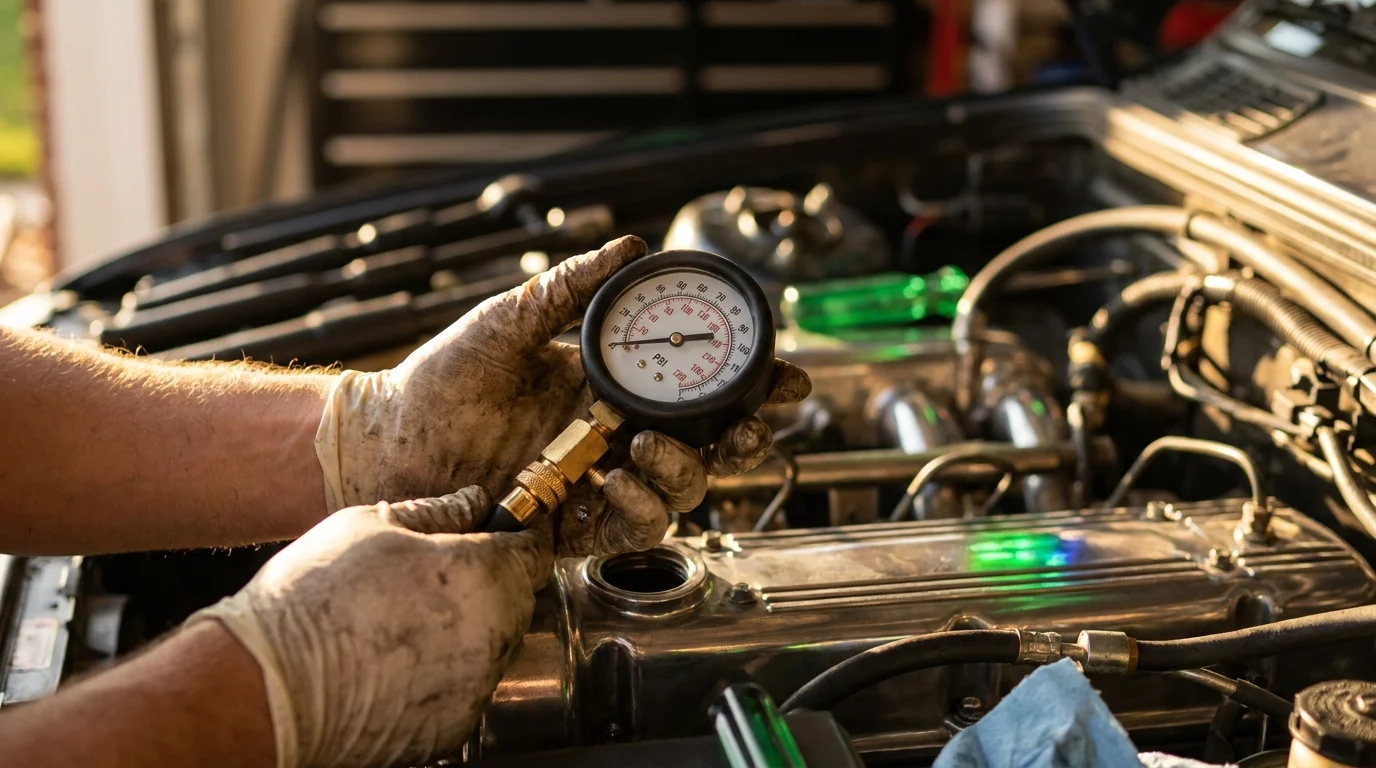
- A compression test before fitting, not after. Once it is in the car, the cost of taking it out again is yours
- Clarity on what is included. Whether the unit comes with the manifold, injectors, turbo and ancillaries changes the real price substantially
Have whoever is fitting it inspect the unit before money changes hands. Any competent garage will do this, and a supplier who objects has answered the question for you.
Get a Second Opinion Before You Commit
At these numbers, a single opinion is not enough. A diagnostic and compression test costs a few hundred dirhams and tells you which of the four options you are actually choosing between — which is worth far more than that on a decision this size.
Be particularly wary of a quote for a rebuild or a replacement that arrives without a compression test having been done. That is a guess, and you are the one paying for it.
Our engine repair and replacement service covers all four routes, and we will tell you plainly when the honest answer is that the car is not worth the spend. Our technicians can run the initial diagnostic at your home or office through our mobile service, so you get a real answer before the car goes anywhere.
Frequently Asked Questions
How much does engine repair cost in Dubai? It depends entirely on the fault. A timing belt or chain typically runs AED 1,500 to 4,500 and a head gasket AED 3,000 to 8,000, while a full rebuild is AED 8,000 to 25,000 and a new or remanufactured engine AED 20,000 to 60,000 or more.
Is it cheaper to rebuild or replace an engine in the UAE? Often neither. For most mainstream cars a low-mileage used or imported engine, widely available here, comes in below the cost of rebuilding your own. On newer or European cars a targeted repair or a remanufactured unit usually makes better sense.
Can you drive with a blown head gasket? You should not. Coolant entering the oil stops it lubricating properly, which damages bearings, pistons and cylinder walls. A defined gasket job becomes a rebuild surprisingly quickly.
What does engine knocking mean? A deep knock that quickens with engine speed usually indicates worn bearings, and it is the most serious noise an engine makes. Stop driving and have it inspected before anything else.
How do I know if my engine is worth repairing? Compare the repair cost against the car's current market value, factor in how long you plan to keep it, and consider the condition of the gearbox, suspension and body. Above roughly half the car's value, the decision needs careful thought.
Why do engines fail more often in Dubai? Heat. Extreme ambient temperatures and stop-start traffic push cooling systems to their limit, and overheating is what warps cylinder heads and cracks head gaskets. Most terminal failures here begin as a cooling problem.
The Cheapest Engine Repair Is the One You Avoid
Nearly every catastrophic engine failure in this city started as something small and cheap — old coolant, a radiator past its best, a temperature gauge that crept up once and was ignored. Servicing the cooling system on time is the highest-return maintenance there is in this climate.
If your engine is already making noises you do not like, get it diagnosed properly before you accept any quote. Get in touch and we will find out what has actually failed, tell you which of the four options fits, and come to you anywhere in Dubai to do it.
Car Aid Team
25 August 2026
Share this article