Engine Oil for Dubai Heat: Which Grade and How Often
Almost every guide to engine oil you will find online was written for a country with a winter. That is why they spend so long on cold starting, and why the advice often does not transfer. Half of what the grade on the bottle describes is behaviour at temperatures your car will never see in the UAE.
What matters here is the other half: whether the oil holds a protective film when the engine is sitting in traffic at 47C with the air conditioning at full load, and how quickly it gives up under that. Get the grade and the interval right and an engine lasts. Get them wrong and you are paying for the consequences years earlier than you should.
Whatever you read here or anywhere else, the specification in your owner's manual is the boundary, not a suggestion. Modern engines are built to run a particular grade, and going outside it causes problems rather than solving them.
What the Numbers on the Bottle Actually Mean
Take 5W-30. It is two separate measurements, not one.
The 5W describes how easily the oil flows when cold. Lower numbers flow better at low temperatures. This is the half of the rating built for northern winters, and in Dubai it is close to irrelevant, because your engine is rarely below 20C even at dawn in January.
The 30 is the one that matters here. It describes the oil's thickness at operating temperature, around 100C. A higher second number means the oil stays thicker when hot, so it holds its protective film under load rather than thinning out and letting metal touch metal.
That is the whole reason UAE guidance leans towards grades like 5W-40 and 10W-40 rather than the thinner options common in Europe. It is not about the first number. It is about what survives the heat.
Which Grade Suits Dubai
| Grade | Where it fits |
|---|---|
| 5W-30 | Common factory fill on newer Japanese and Korean cars. Fine here if it is what the manufacturer specifies |
| 5W-40 | The most widely recommended all round grade for UAE conditions |
| 10W-40 | Well suited to hot climates and to higher mileage engines |
| 15W-40 or 15W-50 | Older engines, heavy loads or sustained extreme heat, only where the manufacturer allows it |
Do not simply go thicker
This is the mistake enthusiastic advice online encourages, and it does real damage.
Modern engines have tight clearances, narrow oil galleries, variable valve timing solenoids and turbocharger oil feeds that are all designed around a specific oil thickness. Put heavier oil into an engine specified for 5W-30 and it flows more slowly through those narrow passages, particularly in the first seconds after start up when most wear happens. You also lose fuel economy, and on some engines you trigger fault codes from timing components that cannot actuate properly.
Thicker is not safer. Correct is safer. If your manual specifies 5W-30 and a full synthetic, use that.
Check for a manufacturer approval, not just a grade
Many European cars require an oil carrying a specific manufacturer approval printed on the bottle, not merely the right viscosity. Using a correctly graded oil without the required approval can affect a warranty claim. If your car is under warranty, this is worth confirming before anyone opens a bottle.
Mineral, Semi Synthetic or Full Synthetic
The base oil matters as much as the grade, and in this climate it matters more than it does anywhere temperate.
Mineral oil thins out and oxidises quickly above 40C ambient. Full synthetic holds its film at high temperature considerably better and resists breaking down for far longer, which is exactly the property Dubai demands. Semi synthetic sits between the two.
| Type | Typical oil cost | Suits |
|---|---|---|
| Mineral | AED 100 to 150 | Older, simpler engines on short intervals |
| Semi synthetic | AED 150 to 250 | Moderate use, budget conscious servicing |
| Full synthetic | AED 250 to 400+ | Almost every modern engine in this climate |
Full synthetic costs more per change and usually works out cheaper per kilometre, because it safely covers a longer interval. In UAE heat it is the sensible default unless your car specifically calls for something else.
How Often to Change It Here
The headline numbers are roughly 5,000 km for mineral oil and 10,000 to 15,000 km for full synthetic. Those are honest starting points and they assume moderate conditions, which Dubai is not.
| Your driving | Suggested interval |
|---|---|
| Mostly highway, full synthetic | 10,000 to 12,000 km |
| Mixed city and highway, full synthetic | 8,000 to 10,000 km |
| Mostly stop start city traffic | 6,000 to 8,000 km |
| Frequent desert or off road driving | 5,000 to 7,000 km |
| Mineral or semi synthetic, any pattern | 5,000 km |
Two rules override the table.
Time counts as well as distance. Oil oxidises with heat whether the car moves or not. If you cover very little mileage, change it at least once a year regardless of what the odometer says. A car that sits through a Dubai summer has aged its oil considerably.
Short trips are harder than long ones. A ten minute drive never gets the oil hot enough to boil off the fuel and moisture that collect in it, so contaminants build up. Counterintuitively, a car used only for school runs and short errands needs oil changed sooner than one doing long motorway runs.
What Dubai Does to Oil That a Mild Climate Does Not
Four things, all of them working against you.
- Thermal breakdown. Sustained high temperatures accelerate oxidation, which thickens the oil, forms deposits and steadily destroys its ability to protect
- Additive depletion. The detergents and anti wear additives in oil are consumed faster at high temperature, so oil can look usable while no longer doing its job
- Sand contamination. Fine dust that gets past a loaded air filter ends up in the oil as an abrasive. This is a genuine local factor, not a theoretical one
- Fuel dilution on short trips. Unburnt fuel washing past the rings does not evaporate if the engine never fully warms, and diluted oil is thinner oil
Signs Your Oil Is Overdue
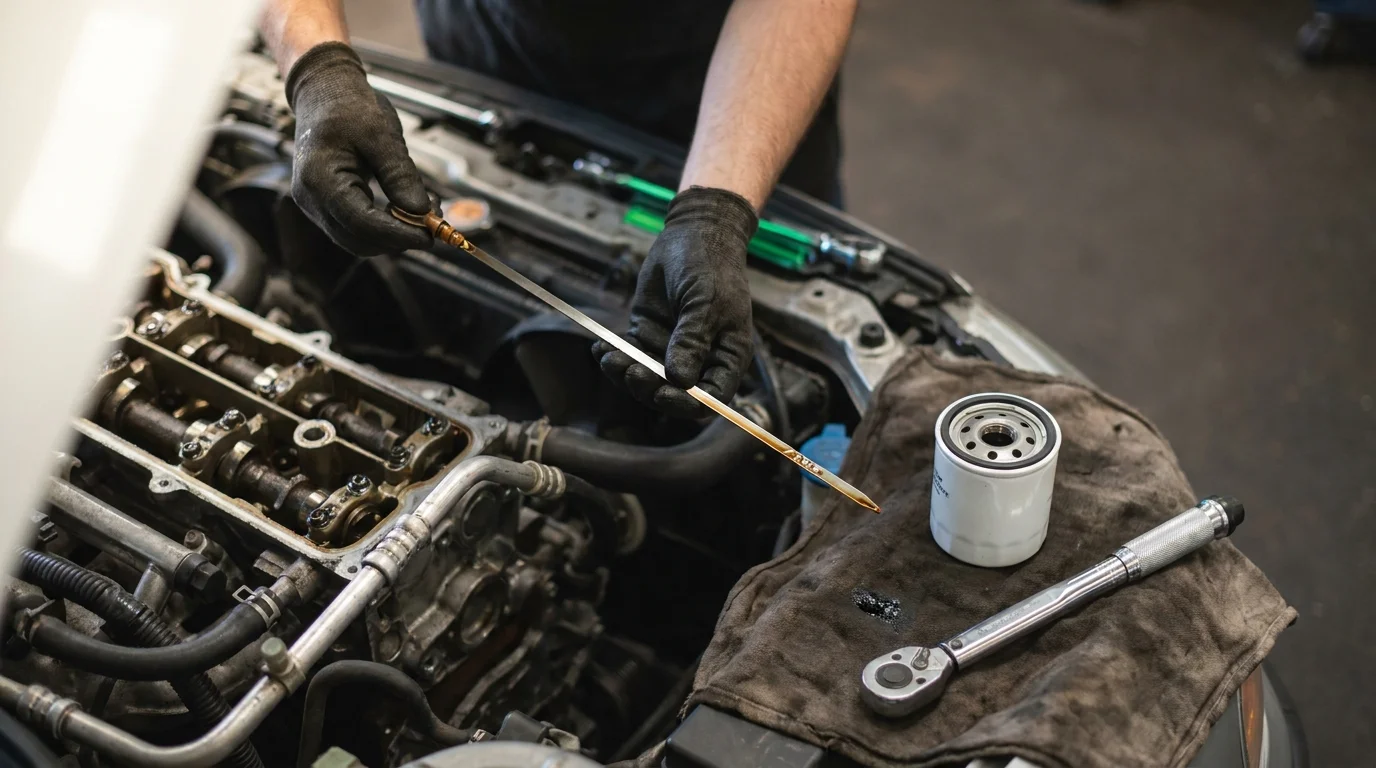
- The dipstick shows very dark, opaque oil rather than translucent amber or light brown
- Oil level dropping noticeably between checks
- A gritty feel if you rub a drop between your fingers
- Engine noise that is louder or harsher than usual, especially on start up
- The oil change or service light illuminated and ignored
Any of these means book it. A dipstick check takes thirty seconds and is worth doing monthly in this climate.
Oil Change Cost in Dubai (2026)
Typical market ranges rather than quotes. Larger engines hold more oil, so a V8 costs meaningfully more than a four cylinder for the same grade.
| Service | Typical Dubai cost |
|---|---|
| Oil and filter change, mineral or semi | AED 90 to 250 |
| Oil and filter change, full synthetic | AED 250 to 500 |
| Premium synthetic or large capacity engine | AED 500 to 950 |
| Air filter replacement, often done alongside | from AED 50 |
| Cabin filter replacement | from AED 50 |
Our car service cost guide sets these alongside the wider service items if you are budgeting a full service rather than an oil change alone.
Can You Do It Yourself?
Mechanically it is one of the simpler jobs. The complication in Dubai is disposal. Used engine oil is a controlled waste, you cannot pour it into a drain or leave it with household rubbish, and arranging proper disposal is usually more hassle than the job saves.
There is also the practical matter of where. Most residents here have a tower basement bay or a villa driveway rather than a garage, and neither is a good place to drain five litres of hot oil.
This is one of the strongest cases for having it done at your home instead. Our home car service covers oil and filter changes on your driveway or in your parking bay, we take the used oil away with us, and there is no trip to a workshop at either end. If the car is somewhere less convenient, our mobile service covers the rest of Dubai the same way.
Frequently Asked Questions
What is the best engine oil for Dubai heat? For most modern cars, a full synthetic in the grade your manufacturer specifies, commonly 5W-40 or 10W-40 in UAE conditions. Full synthetic holds its protective film at high temperature far better than mineral oil, which thins and breaks down faster above 40C.
Is 5W-30 or 10W-40 better in Dubai? Whichever your manual specifies. The second number describes thickness when hot, so 10W-40 stays thicker under heat, but an engine designed for 5W-30 has narrow oil passages and timing components built around that thickness. Use the specified grade rather than assuming heavier is safer.
How often should I change engine oil in the UAE? Every 10,000 to 12,000 km on full synthetic with mostly highway driving, reducing to 6,000 to 8,000 km for stop start city use, and 5,000 km for mineral or semi synthetic. Change it at least annually regardless of mileage, because heat ages oil on its own.
How much does an oil change cost in Dubai? Typically AED 90 to 250 for mineral or semi synthetic and AED 250 to 500 for full synthetic, rising to AED 950 for premium oils or large capacity engines that hold more.
Does my car need an oil change if I barely drive it? Yes. Oil degrades with heat and time as well as distance, and moisture and fuel dilution accumulate in an engine that never fully warms up. Once a year is the minimum in this climate.
Can I mix different engine oils? Topping up with a different brand of the same grade in an emergency will not destroy anything, but it dilutes the additive package and is not a substitute for a proper change. Do not mix different grades or base types as a routine.
The Cheapest Maintenance There Is
An oil change is among the least expensive things you will ever do to a car, and skipping it is among the most expensive. Nearly every engine we see with serious internal wear got there through some combination of heat and neglected oil, and the repair bill is thousands of times the price of the service that would have prevented it. Our guide to engine repair or replacement shows what the other end of that road costs.
If your oil is due, or you genuinely cannot remember when it was last done, get in touch and we will do it at your home or office anywhere in Dubai, with the correct grade for your car and the old oil taken away with us.
Car Aid Team
3 September 2026
Share this article