Car Breakdown in Dubai? What to Do and Fines to Avoid
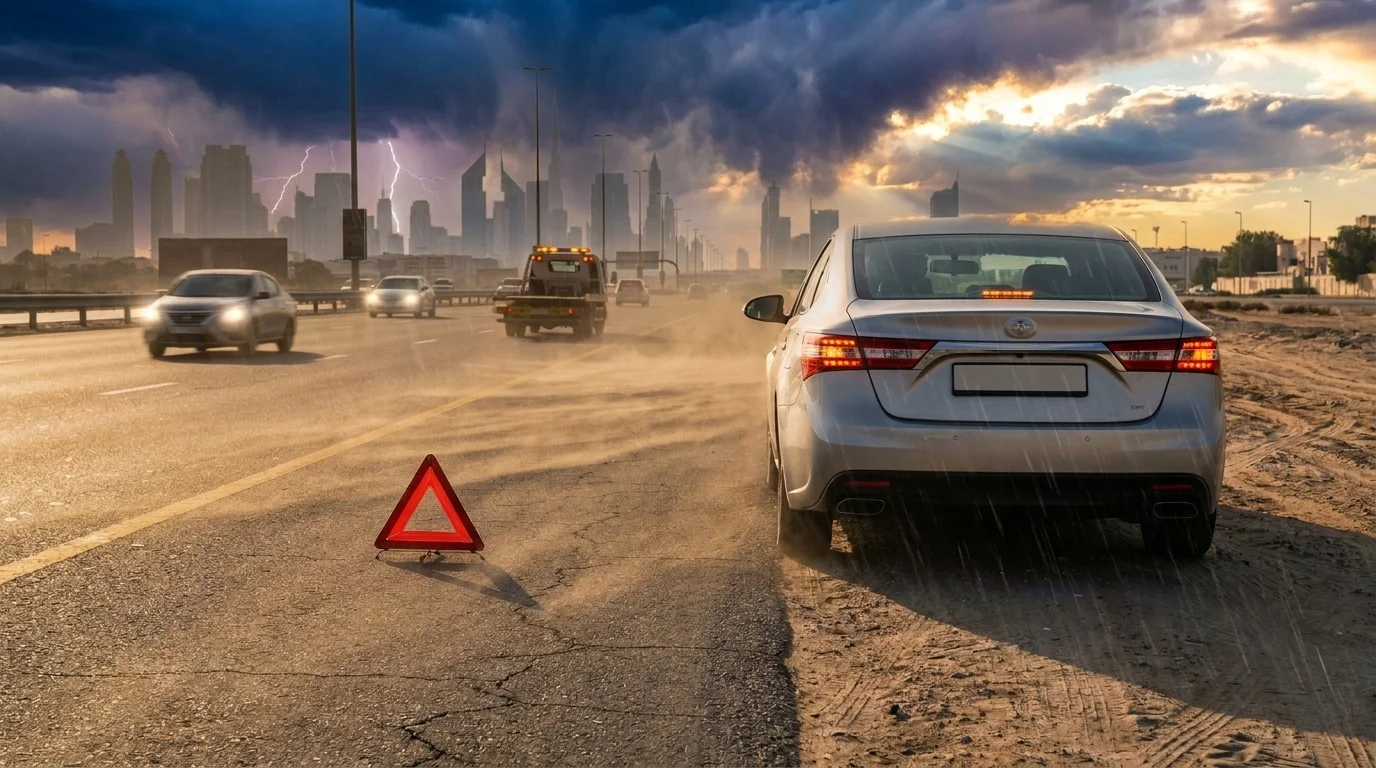
There is a particular kind of panic that comes with a car dying in the middle lane of Sheikh Zayed Road. Traffic is moving at 100 km/h around you, it is 45°C outside, and every decision you make in the next minute matters more than usual.
Most drivers get the mechanical part right and the legal and safety part wrong. They stop in the wrong place, they get out of the car when they should stay in it, they skip the warning triangle, and they end up with fines and black points on top of a repair bill. In the UAE, how you handle a breakdown is regulated, and the penalties are not small.
This is what to do, in order, and what it costs to get it wrong.
If the car is still moving at all, use that momentum to get right. Coasting to the hard shoulder is always better than stopping where you are — a car stopped in a live lane is the single most dangerous outcome.
The First 60 Seconds
In this order, without stopping to think about why the car failed.
- Hazard lights on immediately. Before anything else, even while still rolling
- Steer right and keep momentum. Do not brake hard. Aim for the hard shoulder, an exit, or a slip road
- Get as far off the carriageway as you can. Tight against the barrier, wheels off the running lane
- Keep the steering wheel straight and put the car in Park with the handbrake on
- Assess whether it is safe to get out. Next to fast-moving traffic, it usually is not
- Then call for help. Not before the car is stationary and secure
The instinct to jump out and look at the engine is the one to resist. Diagnosing the fault can wait; being hit cannot.
Where to Stop, and Where Not To
The hard shoulder exists for exactly this. It is not an overtaking lane, and Dubai Police enforce that heavily — 4,504 hard shoulder violations were recorded in Dubai in the first part of 2026 alone. Using it to bypass traffic carries a AED 1,000 fine, six black points, and a possible 30-day vehicle impound.
If you genuinely cannot reach the shoulder, stopping in a live lane is a valid emergency, but it is now urgent. Hazards on, everyone out on the passenger side if it is safe, and behind the barrier — never between your car and oncoming traffic.
Avoid stopping on a bend, over a crest, in a tunnel, or in the blind spot after a junction. If you have any choice at all, take the extra hundred metres to a straight section where drivers can see you coming.
The Warning Triangle Rule Most Drivers Get Wrong
Place the triangle at least 100 metres behind the car, facing oncoming traffic. Not five metres, not just behind the boot. At highway speed, a driver needs that distance to see you and react.
Failing to place one during a breakdown can attract a fine in the region of AED 500 to 1,000. And under Article 98 of the UAE Traffic Law, stopping without a valid reason carries AED 1,000 and six black points, with a further AED 500 for obstructing traffic.
Walk the triangle back along the far side of the barrier where possible, not along the running lane. If traffic is too fast or the shoulder too narrow to do it safely, do not do it at all — stay in the car with your seatbelt on and let the hazards and your call to the police do the work.
Who to Call, and in What Order
| Who | Number | When |
|---|---|---|
| Dubai Police | 999 | Any dangerous position, injury, or live lane |
| RTA roadside assistance | 800 9090 | Recovery and towing on Dubai roads |
| Your insurer | on the policy | If your cover includes recovery |
| A mobile mechanic | — | When the fault may be fixable on the spot |
Call the police first if the car is anywhere unsafe. They will manage the traffic around you, which matters more than the repair.
If you are somewhere safe and the fault sounds minor, a mobile mechanic often saves you the tow entirely. Our 24/7 emergency service covers Dubai at any hour, and a large share of highway breakdowns turn out to be a battery, an alternator or a cooling issue that we can resolve at the roadside rather than recovering the car to a workshop.
The Fines You Can Collect While Broken Down
This is the part nobody expects. Handling a breakdown badly is itself an offence.
| Situation | Penalty |
|---|---|
| Stopping without a valid reason | AED 1,000 and 6 black points |
| Obstructing traffic | AED 500 |
| No warning triangle placed | approximately AED 500 – 1,000 |
| Driving on the hard shoulder to bypass traffic | AED 1,000, 6 black points, possible 30-day impound |
| Blocking an emergency vehicle | AED 3,000 |
Treat these as current guidance rather than a fixed schedule — amounts are revised periodically, and the Dubai Police and RTA channels carry the authoritative figures. The pattern is what matters: the law expects you to make yourself visible and get out of the traffic flow, and it penalises you for failing at either.
Staying Safe in the Heat
A breakdown in a Dubai summer is a heat problem as much as a traffic one, and this is where local advice diverges sharply from the European version.
Standing beside the car on open tarmac in August is genuinely dangerous — surface temperatures well above 70°C radiate upward, and there is usually no shade anywhere on a highway shoulder. But sitting inside a car with no air conditioning is not much better, because the cabin heats fast once the engine is off.
The practical compromise: if traffic makes it unsafe to leave the car, stay belted inside, keep the windows slightly open, and tell the police on the call that you have no air conditioning so they can prioritise you. If you can get safely behind the barrier and there is any shade, take it. Keep water in the car all year — in this climate it is safety equipment, not a convenience.
Never let children or pets remain in a stationary car without air conditioning, even briefly.
What to Keep in the Car
None of this is expensive, and all of it is worth having before you need it.
- A warning triangle, which is the item most cars in Dubai do not actually have
- A reflective high-visibility vest, kept in the cabin rather than the boot so you can put it on before getting out
- At least two litres of water, replaced regularly
- A phone power bank
- A basic first aid kit
- Your insurance details and recovery number saved in your phone, not in the glovebox
Can You Avoid the Tow?
Often, yes. The most common causes of a Dubai highway breakdown are all things a mobile technician can address where the car stopped:
- A dead battery or failed alternator. Frequently fixable on the spot — our jump start service covers this, and our guide to diagnosing a car that will not start explains how to tell which one you have
- Overheating. Not something to drive on, but once cooled it is often a hose, a fan or a coolant issue rather than a terminal fault. We wrote about what to do when a car overheats separately
- A flat tyre, where the spare is usable
- Fuel starvation or a clogged filter
What genuinely needs recovery: a seized engine, a gearbox that will not select a gear, anything with fluid pouring out, and any car left in a position the police want cleared immediately.
Frequently Asked Questions
What should I do if my car breaks down on Sheikh Zayed Road? Hazards on, steer to the hard shoulder using whatever momentum you have, stop as far right as possible, and assess whether it is safe to get out. If traffic is fast, stay belted inside and call 999.
Who do I call for a breakdown in Dubai? Dubai Police on 999 if you are anywhere unsafe, and RTA roadside assistance on 800 9090 for recovery. If the fault may be repairable on the spot, a 24/7 mobile mechanic can often save you the tow.
Is there a fine for breaking down on a UAE highway? Not for the breakdown itself, but there are penalties for how it is handled — stopping without valid reason carries AED 1,000 and six black points, obstructing traffic AED 500, and failing to place a warning triangle roughly AED 500 to 1,000.
How far behind the car should the warning triangle go? At least 100 metres, facing oncoming traffic. Only place it if you can do so without walking in a live lane.
Should I stay in the car or get out? Next to fast-moving traffic, stay inside with your seatbelt fastened. Get out only if you can move safely behind a barrier, and always exit on the side away from traffic.
Can a mobile mechanic fix a car on the highway? Many faults, yes — batteries, alternators, cooling problems, tyres and fuel issues are commonly resolved at the roadside. Seized engines, gearbox failures and major leaks need recovery.
Be the Driver Who Handles It Well
A breakdown is bad luck. The fines, the black points and the near-misses that follow are usually decisions. Hazards on, get right, stay visible, stay out of the traffic, and call before you start investigating.
Car Aid Auto Mobile Repair Service has been reaching stranded drivers across Dubai since 2011, at any hour, in any weather. If you are stopped somewhere right now, our emergency team will come to you — and if you would rather not find out the hard way, get in touch and we will check the car over before it lets you down.
Car Aid Team
28 August 2026
Share this article